Why humidity affects furniture faster than most people expect
Furniture in Singapore faces conditions that would be considered extreme in most other climates. Relative humidity between 70 and 90 percent, sustained year-round, creates an environment where moisture damage is not an occasional risk but an ongoing process. The damage accumulates incrementally — which is precisely why it is often noticed only after it has become significant.
The materials most commonly used in residential furniture — solid wood, MDF, plywood, leather, foam, and textile upholstery — all respond to sustained humidity in different ways and on different timescales. What follows is a material-by-material guide to the signs of damage, organised from early to advanced stages.
Solid wood furniture
Early signs: Drawers that previously slid smoothly begin to stick and require force to open or close. This is caused by the wood expanding across the grain — typically the first noticeable symptom in cabinets and dressers. Doors that no longer close flush with their frames indicate the same process in larger structural pieces.
Intermediate signs: Visible gaps opening along joints where two wood pieces meet — particularly in table tops, chair backs, and cabinet frames. These gaps are caused by uneven moisture uptake: the outer surfaces of a board expand more than the centre, creating differential stress that pulls joints apart. A musty odour emanating from closed storage pieces, even when empty, indicates mold colonisation in progress.
Advanced signs: Warped table tops — surfaces that were flat now rock or show a visible bow. White or grey powder on the wood surface (efflorescence) in pieces stored near exterior walls. Black spots or fuzzy growth visible on back panels, undersides, and in corners where air circulation is minimal.
MDF and particleboard furniture
Medium density fibreboard and particleboard — used extensively in flat-pack and budget furniture — are highly sensitive to moisture because their wood fibre binders are water-soluble. Once moisture penetrates the surface finish, the board swells irreversibly.
Early signs: Slight swelling at edges, particularly at cut edges that were not sealed during manufacturing. Veneer or laminate lifting at corners and edges — this separation indicates the adhesive bond has been compromised by moisture from below.
Advanced signs: Visible white bloom under surface laminates, indicating the board core has absorbed moisture and begun to degrade. Structural softness — the material crumbles or dents when pressed. At this stage, the piece cannot be repaired and must be replaced.
Leather upholstery
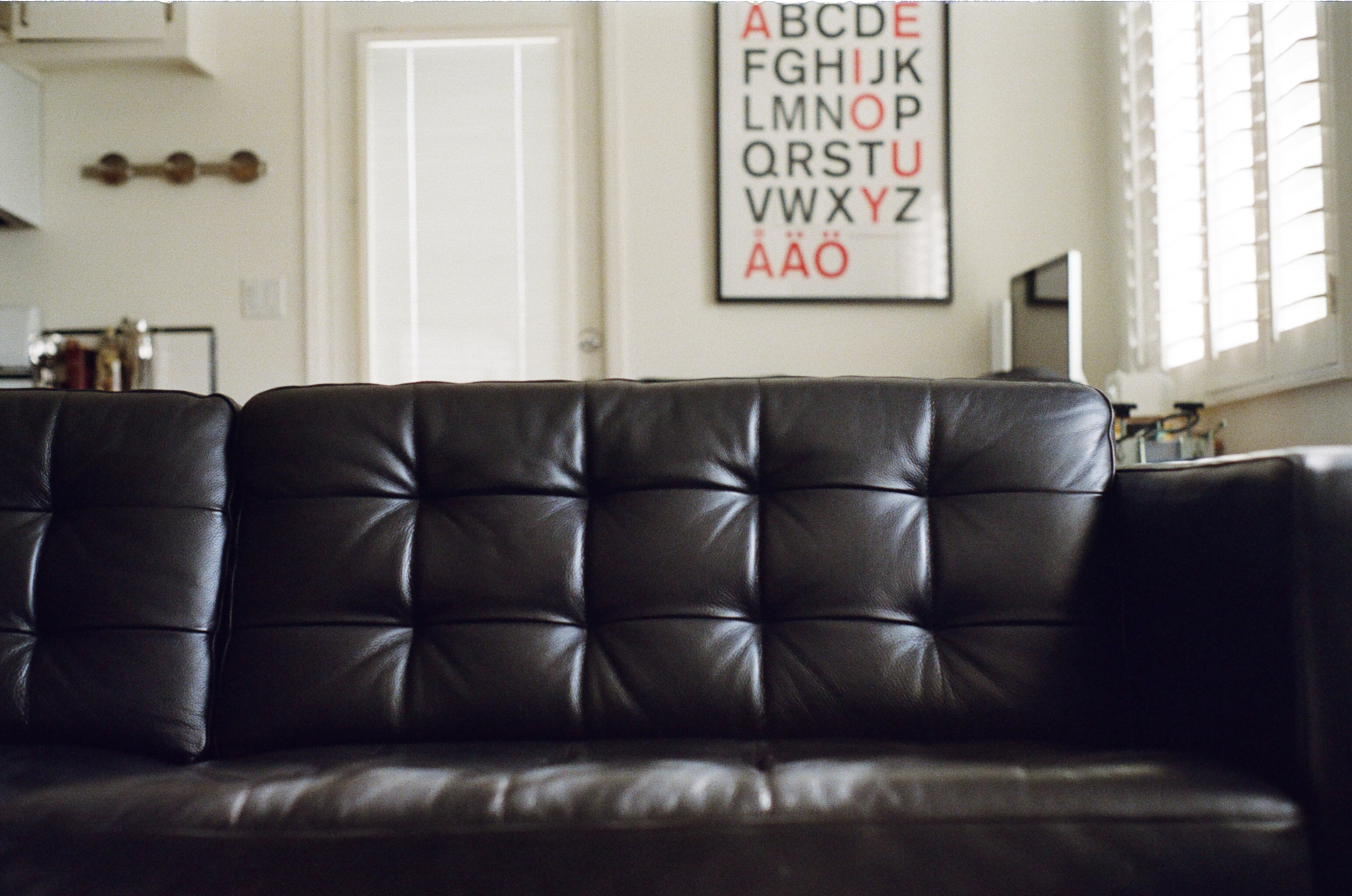
Leather is an organic material that is both hydrophilic (attracts water) and susceptible to biological colonisation at high humidity. The most common pattern of moisture damage in leather furniture in Singapore follows a predictable sequence.
Stage 1 — Surface mold: Small white or grey spots appearing in seat creases, armrest undersides, and cushion edges. These spots wipe away initially but return within days if the underlying humidity problem is not addressed. The musty smell associated with leather mold is distinct and persistent.
Stage 2 — Leather drying: Counterintuitively, sustained high humidity ultimately dries leather by encouraging the growth of mold that consumes the leather's natural oils. After mold exposure, leather appears dull, slightly stiff, and develops hairline cracks in areas of flexion — seat bends, armrest edges, and cushion folds.
Stage 3 — Irreversible cracking: Deep fissures opening across the leather surface, particularly at corners and stitching lines. At this stage, conditioning can slow further deterioration but cannot reverse the cracking. Full re-upholstery or piece replacement is the practical outcome.
Textile upholstery, cushions, and rugs
Textile fibres trap airborne moisture and provide a hospitable environment for mold and mildew. The first sign is almost always olfactory — a musty or damp smell that persists even after airing.
Visible mold on textiles typically appears as dark spots or patches — grey, black, or greenish — concentrated in areas where the fabric is folded, compressed against a wall, or in low-circulation zones (under cushions, in sofa corners, beneath rugs). Textile mold penetrates fibre structure rapidly and is difficult to eliminate completely once established.
Foam cushion cores — whether polyurethane or memory foam — absorb moisture and do not release it readily. A cushion that feels heavy, takes several days to dry after exposure to humidity, or has developed a persistent odour has likely developed internal mold in the foam. This is not cleanable and the foam core should be replaced.
Metal hardware and mechanisms
Metal components — hinges, drawer slides, adjustment mechanisms in beds and desks, and decorative hardware — corrode in sustained high humidity. Surface oxidation appears first as a dull film, then as orange-brown rust staining on the metal itself and on adjacent surfaces.
Mechanisms that have begun to rust seize gradually: drawer slides become rough, then sticky, then immovable. Hinge pins corrode at their pivot points. Adjustable furniture mechanisms — particularly in gas-lift beds and modular shelving — fail suddenly when corrosion reaches the load-bearing point. Regular application of a dry silicone lubricant (not oil-based, which attracts dust) extends the service life of metal components in humid environments.
Prioritising what to address first
When surveying a home for moisture damage, address issues in this order: first eliminate active moisture sources (plumbing leaks, blocked AC drains, missing vapour barriers under flooring), then control ambient humidity to the 55–65% range, then assess which pieces can be treated versus which should be replaced.
Treating damage while the moisture source remains active accomplishes nothing. Mold returns, leather continues to crack, and wood continues to swell regardless of surface treatment if the underlying humidity problem is unresolved.